With rising global temperatures, finding eco-friendly solutions to cool our homes has become a priority. Yet, the answer to this contemporary challenge has existed for centuries in the heart of the Medina of Fez.
The architecture of traditional Moroccan Riads is not only an aesthetic masterpiece; it is a pioneering model of bioclimatic architecture and passive thermal regulation.
Discover how these centuries-old homes defy the heat without intensive air conditioning, and why they represent the future of sustainable housing.
1. The chimney effect: Natural ventilation through the patio
The central patio is the beating heart of the Riad, but it is also its thermal lung.
- The mechanism: During the night, cool air naturally settles in the open-air courtyard. During the day, as the sun heats the roof, the warm air rises and escapes upwards.
- The result: This movement creates a depression that draws fresh air from the patio directly into the surrounding rooms. A natural and continuous ventilation system is established, cooling the atmosphere without using a single kilowatt of electricity.
2. Thermal inertia: The shield of thick walls
In a traditional Riad, the very structure of the building serves as a barrier against the outside heatwave.
- The mechanism: The exterior walls, built from terracotta bricks or rammed earth, are considerably thick. These materials have high "thermal inertia," meaning they absorb the sun's heat very slowly.
- The result: The heat accumulated during the day's walking in the Medina never penetrates the wall. It is stored within the structure's mass and only released to the outside at nightfall, when temperatures drop. Inside, the temperature remains stable and comfortable.
3. Adiabatic cooling: The importance of water and vegetation
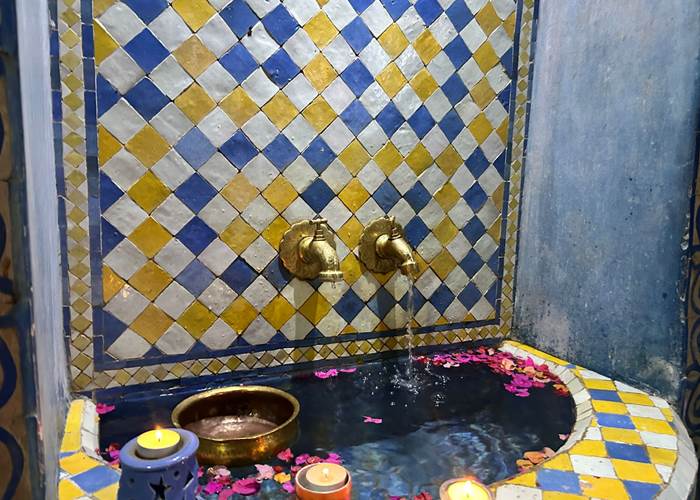
The introduction of natural elements into the center of the Riad is not merely decorative: It is an evaporative air conditioning system, scientifically called adiabatic cooling.
- The mechanism: The presence of a real swimming pool, combined with the vegetation of the patio (green plants, shrubs), creates a humid microclimate.
- The result: When warm air touches the surface of the water and plants, the water slowly evaporates. This evaporation consumes heat and naturally lowers the ambient temperature by several degrees while purifying and humidifying the dry summer air.
A model for the future of sustainable tourism
Faced with climate change, the architecture of traditional riads reminds us that ancestral engineering offers remarkably effective solutions. Choosing to stay in or draw inspiration from a riad means rediscovering an ecological, logical, and environmentally conscious comfort.